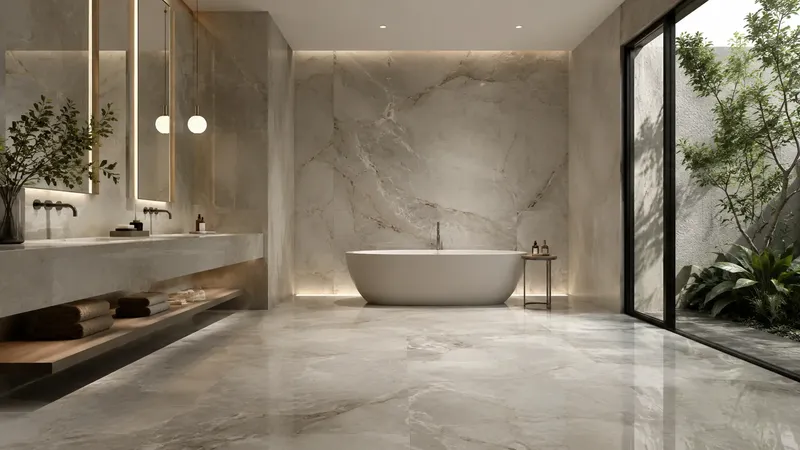
Tiles and flooring from China: the questions buyers ask first
Four questions come up in almost every first enquiry: will the shade match the sample I approved, will it arrive unbroken, what does it really cost per square metre, and can I order less than a container.
Tiles and flooring are heavy and break easily in transit, so all four are fair questions. Our answer is a sealed physical sample, a written specification and photo records at every stage.
We make porcelain and ceramic tiles, sintered stone slabs and flooring in our own 100,000 m² factory in Foshan, China. Mixed-container loading puts a flooring order in the same container as your cabinets, doors, stone and sanitary ware.
Send your floor plan or BOQ on WhatsApp (+86 133 0284 3989) — a coordinator replies within one working day.
What we make
Porcelain and ceramic tiles
Floor-rated porcelain with water absorption below 0.5%, in polished, lappato, matt and structured surfaces.
Wood-look planks carry eight to twelve grain faces, so a laid floor does not visibly repeat the same board. We also run stone-look, terrazzo-look, cement-look and zellige-style walls, plus herringbone, hexagon and mosaic formats.
Outdoor and pool-deck tiles are available with slip ratings up to R13. Shower-floor tiles ship with matching drain trims, and bullnose, cove base, stair nosing and tile edge profiles are made in the same body and shade as the main tile.
Sintered stone and large-format porcelain slabs
Large-format slabs run from 1200×2400 mm to 1600×3200 mm in 6 mm, 9 mm and 12 mm, for floors, feature walls and cladding. Slabs can be selected as book-matched pairs for a mirrored grain across a wall. For flooring, 9 mm and 12 mm are usual: fewer joints and a flatter reading across a large room.
Flooring: SPC, engineered wood and laminate
SPC rigid-core planks in 4–6 mm with an IXPE acoustic underlay are fully waterproof and lock together without adhesive. Engineered wood comes in 15 mm and 18 mm with a 2–4 mm hardwood wear layer, brushed and oiled or UV lacquered. Laminate is supplied in 8 mm and 12 mm, AC3 to AC4 wear classes.
All three accept matching skirting, stair nosing and thresholds from the same production run.
Material comparison
| Material | Water resistance | Typical formats | Typical use | Relative cost |
|---|---|---|---|---|
| Ceramic wall tile | Glazed, wall only | 300×600, 300×900, 400×800 mm | Kitchen backsplashes, interior walls | $ |
| Glazed porcelain floor tile | Absorption below 0.5% | 600×600 to 1200×1200 mm | Living areas, wet rooms, corridors | $$ |
| Wood-look porcelain plank | Absorption below 0.5% | 150×900, 200×1200 mm | Bedrooms, hotels, high-traffic floors | $$ |
| Sintered stone slab | Below 0.1%, stain resistant | 1200×2400 to 1600×3200 mm | Feature walls, floors, cladding | $$$$ |
| SPC rigid core | Fully waterproof | 1220×180 mm plank, 4–6 mm | Apartments, basements, fast fit-out | $$ |
| Laminate | Moisture-resistant core | 8 mm, 12 mm, AC3–AC4 | Bedrooms, dry commercial space | $ |
| Engineered wood | Handles humidity better than solid | 15 mm, 18 mm, 2–4 mm veneer | Villas, living rooms, premium bedrooms | $$$ |
Not sure which of these suits your rooms? Send one photo of the space and we will come back with two or three options — WhatsApp (+86 133 0284 3989).
Configurations
| Item | Options |
|---|---|
| Tile size | 300×300 up to 1600×3200 mm (slab) |
| Thickness | 6, 8, 9, 10, 12 mm |
| Surface | Polished, lappato, matt, satin, structured, bush-hammered, brushed |
| Edge | Rectified, cushion, rustic |
| Slip rating | R9 dry interiors · R10–R11 wet rooms · R11–R13 outdoor and pool decks |
| Wear class | PEI III–V, domestic through commercial |
| Grout joint | 1.5, 2, 3 mm, or tight-joint slab installation |
| Flooring core | SPC rigid core, engineered multilayer, laminate |
| Wear layer / veneer | 0.3–0.55 mm vinyl wear layer · 2–4 mm hardwood veneer |
| Underlay | IXPE acoustic, cork, or none (direct to screed) |
| Accessories | Skirting, stair nosing, thresholds, bullnose, cove base, expansion joints |
Anything not listed — a special length, a matched shade for an existing floor — is quoted as a custom line, confirmed in writing before production.
How to choose, by project type
Villa or whole-home fit-out
One stone-look porcelain across the ground floor, wood-look porcelain in bedrooms and a matching matt version outdoors keeps the palette calm and the maintenance simple.
For engineered wood, ask about the wear layer rather than plank thickness — a 4 mm veneer can be sanded and refinished, a 2 mm veneer cannot.
Apartment developments
Repeatable modules matter more than variety. Standard 600×600 or 900×900 porcelain rooms out predictably, and SPC over screed shortens the fit-out programme because it needs no adhesive curing time.
We pack apartment orders by unit number, so the installer opens one set of pallets per flat instead of sorting stock on site.
Hotels, restaurants and commercial interiors
Specify R10 or above for bathrooms and back-of-house areas, and AC4 or a 0.55 mm wear layer for corridor flooring. Large-format slabs suit lobbies: fewer joints, quicker cleaning and a more continuous surface under lighting.
Distributor and trade stock
Mixed pallets across core colours and sizes let you test a market without committing a full container to one line. Shade consistency between repeat orders is controlled by keeping the production batch on file with your master sample.
Building a schedule of finishes? Send your BOQ and we will return an itemised quotation by room — WhatsApp (+86 133 0284 3989).
Price ranges
Everything is priced per specification and every quotation is itemised line by line. The column below ranks each material by relative cost.
| Material | Relative cost |
|---|---|
| Ceramic wall tile | $ |
| Glazed porcelain floor tile | $$ |
| Wood-look porcelain plank | $$ |
| Outdoor and pool-deck tile | $$ |
| Sintered stone slab | $$$–$$$$ |
| SPC rigid core | $ |
| Laminate | $ |
| Engineered wood | $$$ |
Five things move the price:
- Material class and thickness — a 12 mm sintered slab and a 4 mm SPC plank are not in the same cost bracket.
- Surface and format — bush-hammered and book-matched surfaces take more process time than a standard matt finish.
- Batch size and customisation — custom colours, matched shades and unusual formats carry a minimum run.
- Packing standard — export crates, foam interleaving and reinforced pallets cost more and reduce breakage.
- Freight and consolidation — tiles reach a container’s weight limit before its volume, so how your order is loaded with other categories changes the landed cost per m².
Design work is quoted as a fixed fee before it starts, and when your order reaches twenty times that fee, the design fee is credited back in full. Most whole-home orders reach it without trying.
MOQ and mixed-container loading
We do not operate a fixed minimum order per tile or plank reference. The practical minimum is what can be loaded and shipped economically.
A 20 ft container reaches its weight limit at roughly 1,200 m² of 10 mm porcelain — the container is not full, it is too heavy. That is why mixing matters: pairing heavy tile with lighter categories such as doors, lighting or soft furnishing fills the container properly and spreads the freight cost across the whole order.
Practical rules we work to:
- Small quantities of one finish can be added to a mixed-container order with other categories.
- Allow roughly 2–3% spare tile for cuts, breakage and future repairs, quoted as a line item so you can decide.
- One order, one packing list, numbered by room or unit, so unloading matches your site sequence.
- Tile, stone, flooring, cabinets, doors and sanitary ware can all ship together from the same Foshan warehouse.
Quality control: what you can check without flying to Foshan
Shade and calibration are where tile and flooring orders normally go wrong, so the checks target those risks.
- Specification before production — tile code, size, thickness, surface, slip rating, grout joint and layout direction are confirmed against your drawings and a sealed master sample.
- Batch control — the production batch and shade number are frozen at approval and recorded on your file, so a repeat order matches rather than merely resembles.
- In-production records — photos and video from pressing, glazing, calibration and the sorting line. For wood and SPC we record moisture content and core checks.
- Pre-shipment inspection — shade variation against the master sample, flatness and warpage, dimensional tolerance, water absorption, slip and wear-layer checks, plus a carton count against the packing list.
- Numbered packing list and loading photos — every pallet is labelled by room or unit, and you receive photographs of the container being loaded so you can see exactly what left the factory.
If you prefer third-party verification, inspections by SGS, BV or TÜV can be arranged on your behalf. Certificates are shared on request per category — tell your coordinator which market you import into and we will send the documents before you order.
Two things we state up front
Installation is not included unless separately agreed. We supply, pack and ship; your local team installs, with our shop drawings and remote support during the fitting.
Colours and finishes are approved on physical samples, not screens. Product images should not be used as the final acceptance basis — a monitor is not a quality standard, and wood- and stone-look surfaces vary by nature within an agreed range.
Want the inspection checklist we use on tile orders? Ask on WhatsApp (+86 133 0284 3989).
Lead time and shipping
Standard production after drawing approval: porcelain and ceramic tiles 20–30 days, sintered stone slabs and SPC 25–35 days, engineered wood and laminate 30–40 days. Custom formats, matched shades or wide-format slabs run longer; dates are confirmed before you pay a deposit.
Shipping runs by sea, FCL or LCL, from Foshan or Shenzhen to your port. Pallets are strapped and corner-protected, large-format slabs travel in A-frame crates, and pallets are heat-treated to ISPM 15 where required. Export documents, packing lists and loading photos are issued with the shipment.
The order runs through six steps: Share Your Brief → Design & Quotation → Approve the Details → Production & QC → Packing & Shipping → Delivery & Support. Production only starts after you approve the details; standard terms are a deposit before production with the balance before shipment.
Frequently asked questions
What is your minimum order for tiles or flooring?
There is no fixed minimum per reference when the order ships as a mixed container. A single finish in small quantity can be added to an order with other categories, and a container of tiles alone is also fine. Your coordinator confirms the loading plan before you commit.
How do I confirm the colour before you ship?
We courier a physical sample and seal a master copy against your order. Shade, surface and size are then checked against that sealed sample at pre-shipment inspection, and the photos go to you. This is why product images alone are never treated as final acceptance.
How do you stop tiles from breaking in transit?
Cartons are stacked on reinforced pallets with edge boards and strapping; large-format slabs ship vertically in A-frame crates with foam between pieces. Loading photographs document the packing before the doors close.
Can tiles and flooring ship in the same container as cabinets, doors and stone?
Yes — that is normal practice for us. Heavy tile is balanced against lighter, bulkier categories so the container meets its weight and volume limits at roughly the same time. Everything is listed on one packing list numbered by room or unit.
What slip rating do I need for outdoor and pool areas?
Pool decks and external walkways are usually specified from R11 upward, with R13 for wet ramps and slopes; indoor wet rooms commonly sit at R10. Local building codes and your installer have the final say, and we will send the test data so your architect can confirm.
Is SPC or engineered wood suitable for underfloor heating?
SPC is generally suitable for underfloor heating within the system’s temperature limits; engineered wood depends on core stability and how the heating is controlled. Give us the heating specification and we will confirm which construction is appropriate rather than assume.
Which certifications can you provide?
Certificates are shared on request per category, because requirements differ by market and product. Tell us the destination country and the standard your project needs, and your coordinator will send the documents with your quotation.
How long from order to delivery?
Production typically takes 20–40 days depending on material, then sea freight on top — around two to four weeks to major Asian and Middle East ports, four to six weeks to Europe and Africa, longer to the Americas. Your coordinator confirms a schedule for your port before you pay the deposit.
Start with a floor plan, a BOQ or a single room
You do not need a complete specification to begin. A floor plan, a room photo or a list of areas will do — we will come back with material options, a fixed design fee and an itemised quotation.
George Group Home, part of George Group, has 20 years’ industry experience, 10,000+ projects delivered across 50+ countries. Ivana, our senior sales director, worked in the UK for five years and handles English-speaking buyers directly.
WhatsApp +86 133 0284 3989 (UK line +44 7719 795480), email ivana.li@george.cn, or write to us at Tower One, No.46 Jihua 3rd Road, Chancheng District, Foshan, Guangdong, China. A coordinator replies within one working day.